

Free hourly rate calculator for contractors and freelancers
Your hourly rate comes from three things: what you need to take home, what it costs to keep your business running, and the hours you actually bill a client. Type your numbers below and the calculator gives you your minimum hourly rate, your day rate and what a job of any length is worth.
We don't give you anyone else's prices: we only do the math with your numbers, and what you type stays in your browser.
Now you have your rate. In Chambaly you save it once, and every estimate you dictate by voice uses it, with labor and materials split out. Try Chambaly free.
How do you calculate an hourly rate?
- Add the take-home pay you want per month and your monthly business costs. Multiply by 12: that's what the business has to bring in each year.
- Multiply the hours you bill per week by the weeks you work per year. Those are your billable hours.
- Divide the yearly amount by your billable hours. That's your rate before taxes.
- Divide by (1 minus your tax set-aside). If you want profit for the business on top, add it last.
The calculator shows every step with your numbers under the result, so you know where the rate comes from.
Why not just charge what everyone else charges?
Because nobody else pays for your truck, your insurance or your tools, and nobody else works your hours. If you copy someone's price and your costs are higher, you end up working more for less. Knowing your minimum tells you when a job isn't worth it and when you can come down a little without losing money.
Which hours count?
Only the hours you bill a client. Driving to the job, picking up materials, writing estimates and chasing payments are work too, but nobody pays you by the hour for them. If you work 50 hours a week, you may only bill 30 or 35. Enter billed hours, not worked hours, or your rate will come out too low.
How much should I set aside for taxes?
If you're self-employed, the IRS charges a 15.3% self-employment tax (12.4% for Social Security and 2.9% for Medicare). Income tax can come on top, depending on how much you earn and your situation. Read the IRS page on self-employment tax and ask your tax preparer if you're unsure. You choose the percentage in the calculator.
Example
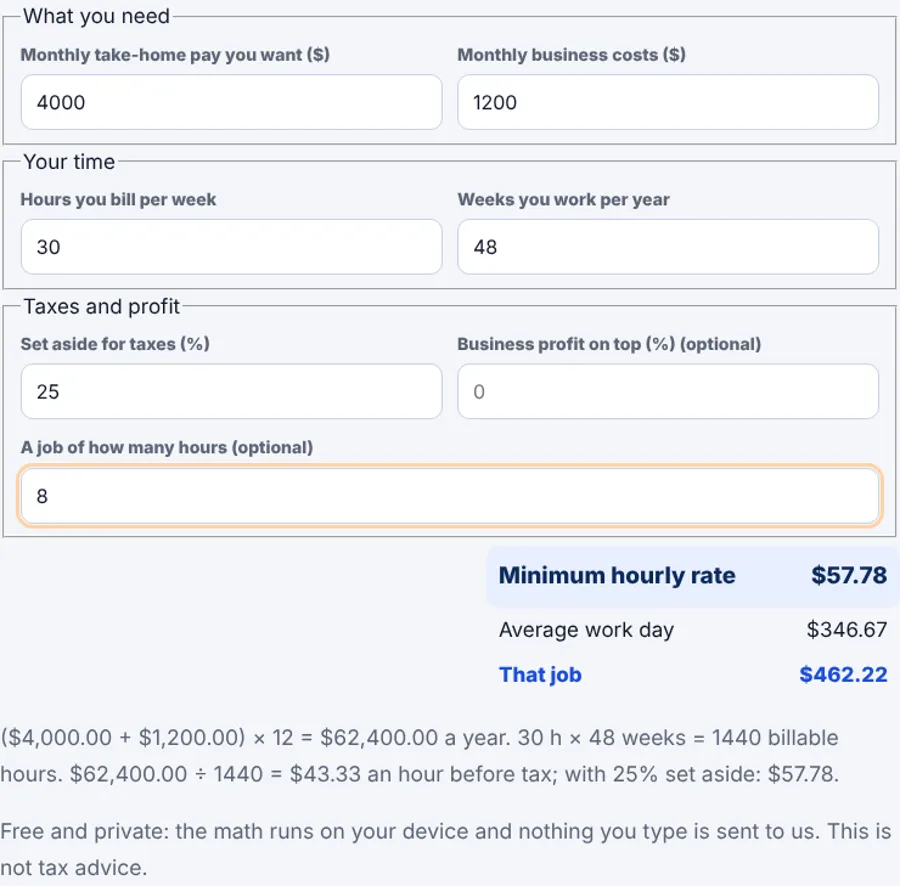
This is only an example with made-up numbers, not a recommended rate. Ana wants to take home $4,000 a month and her business costs $1,200 a month. She bills 30 hours a week and works 48 weeks a year. She sets aside 25% for taxes and adds no extra profit.
- ($4,000 + $1,200) × 12 = $62,400 a year.
- 30 hours × 48 weeks = 1,440 billable hours.
- $62,400 ÷ 1,440 = $43.33 an hour before taxes.
- $43.33 ÷ 0.75 = $57.78 an hour, and an average work day (6 billed hours) comes to $346.67.
What if I price by the job instead of by the hour?
Many trades quote by the job or by the square foot. Your hourly rate is still the base: estimate how many hours the job takes, multiply by your rate and add materials separately. Then build the estimate with the free estimate generator and bill it with the free invoice generator. For more on pricing a job, read how to write an estimate.
Frequently asked questions
Does the calculator tell me what other contractors charge?
No. It uses only your numbers: what you want to take home, your costs and the hours you actually bill. We don't publish average rates because we have no reliable source for your trade and city.
How much should I set aside for taxes?
The IRS self-employment tax is 15.3% (12.4% Social Security and 2.9% Medicare). Income tax depends on your situation, so you choose the percentage. This is not tax advice.
Do you save what I type?
No. The math runs in your browser and nothing is sent to our server.
What if I price by the job, not by the hour?
Estimate how many hours the job takes and multiply by your hourly rate; the “a job of X hours” line does it for you. Then add materials separately on your estimate.