 Chambaly
How to write an estimate for a job, step by step
When a customer asks for a price, they are often asking other contractors too. The job usually goes to whoever answers first with something clear and professional, not always to the cheapest bid.
A good estimate does three things. It tells the customer exactly what they get, it protects you from "I thought that was included," and it makes saying yes easy. A single number in a text message does none of those.
This guide covers what to put in an estimate, a sample line-item layout, the mistakes that cost you money, and how to write one from your phone with AI while you are still at the job.
Estimate, quote or bid: what is the difference?
People use these words loosely. In general, an estimate is your best price for the work based on what you know now, and it can change if the job changes. A quote is usually a fixed price for a clearly defined job. A bid is a price you submit to compete for a project. Whatever you call it, write down what is included and how long the price is good for.
What to include in an estimate
- Your business info. Business name, phone and email, so the customer knows who to call.
- Customer and job info. Name, job address, date and a short description of the scope.
- Line items. Labor and materials in separate sections. Each line gets a quantity, a unit (hour, sq ft, piece, job) and a price.
- Totals. Subtotal, any discount, sales tax if you charge it, and one clear total.
- Deposit. How much you need up front to buy materials and hold the date.
- Valid until date. Material prices change. Say how long your price holds.
- Payment options. Zelle, Venmo, Cash App, cash or check, whatever you take.
- What is not included. A line like "Changes to the scope will be priced separately" prevents a lot of arguments.
Sample estimate line items
Here is how a small bathroom fan replacement might look. The prices are made up for this example; use your own.
| Section | Item | Qty | Unit | Price |
|---|---|---|---|---|
| Labor | Remove old fan and install new fan | 3 | hour | $60 |
| Labor | Patch and paint ceiling around fan | 1 | job | $75 |
| Materials | Bathroom exhaust fan with light | 1 | piece | $140 |
| Materials | Duct, clamps and vent cap | 1 | job | $35 |
| Other | Haul away old fan and debris | 1 | job | $25 |
How to write an estimate, step by step
- Walk the job and take notes. Measure, take photos and ask what the customer expects. Most bad estimates start with a rushed walkthrough.
- List your labor. Break the work into tasks and price each by the hour, by the square foot or by the job.
- List your materials. Include everything you will buy, plus a markup for your time picking it up.
- Add the terms. Deposit, valid until date, payment options and what is not included.
- Check it and send it the same day. Read every number before it goes out.
How to write an estimate from your phone with AI
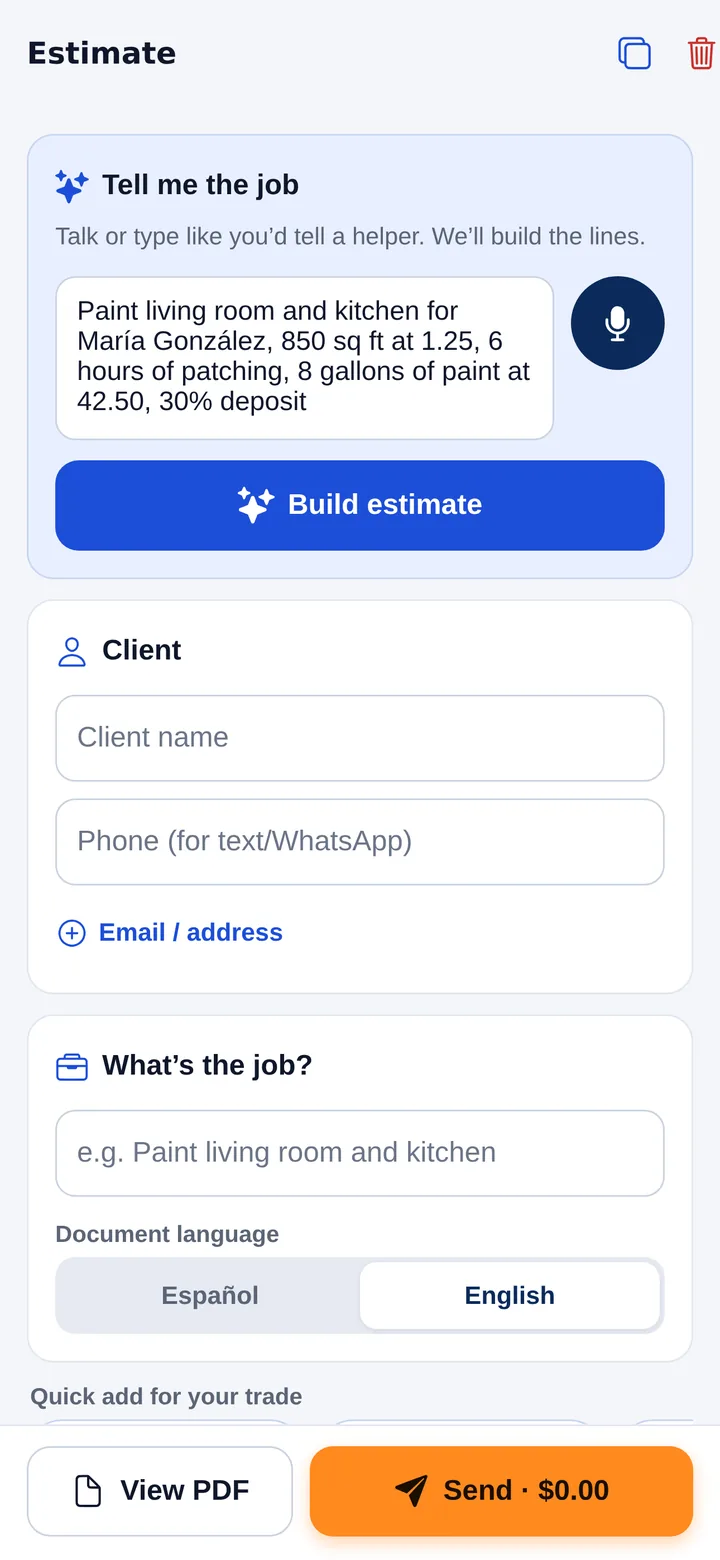
If you hate typing or you are not a computer person, you can talk instead. In Chambaly you tap the mic and describe the job the way you would tell a helper: "Replace bathroom fan, 3 hours at 60, patch and paint the ceiling, fan with light at 140, haul away the old one, half down."
- AI builds the lines. It sorts labor, materials and other charges, with quantities and units.
- You stay in charge of price. If you did not give a price, AI suggests one and marks it for you to check. The price is always yours.
- Your markup stays private. Markup on materials stays inside the price, and only you see it.
- Send it anywhere. A clean PDF goes out by text message, WhatsApp or email, with your business name, every line, the deposit and how to pay you.
- English or Spanish. You can write in one language and send the document in the other. AI translates your lines.
Chambaly also has ready-made common line items for 16 trades, so you are not starting from a blank page.
Common estimate mistakes
- Guessing instead of measuring. Your measurements are your defense when a customer says it is too expensive.
- One lump sum with no breakdown. It looks informal and invites haggling.
- Vague scope. "Fix bathroom" means something different to you and to the customer.
- No deposit and no expiration date. You carry all the risk, and the customer can hold you to an old price.
- Sending it days later. By then, someone else may already have the job.
After the customer says yes
Mark the estimate as accepted and turn it into an invoice in one tap, with the same lines and the deposit already figured. Our guide on how to make an invoice covers what the invoice needs. If payment runs late, see how to collect overdue invoices without burning the relationship.
Questions
Is an estimate legally binding?
It depends on your state, the wording and what both sides signed. Many contractors treat an estimate as a price that can change if the scope changes. If you need a firm contract, talk to a local attorney.
How long should an estimate be valid?
There is no single rule. Pick a period that fits how fast your material costs change, and write the valid until date on every estimate.
Should I charge for estimates?
Many trades give free estimates for simple jobs and charge for detailed design work or long site visits. Decide your policy and tell the customer before you go out.
Can AI price the job for me?
AI can suggest a price when you do not give one, and it marks that line for you to check. You know your costs and your area, so the final price is always yours.
Can I use Chambaly now?
Chambaly is coming soon to iPhone and Android. Leave your email on this page and we will let you know when it is ready.